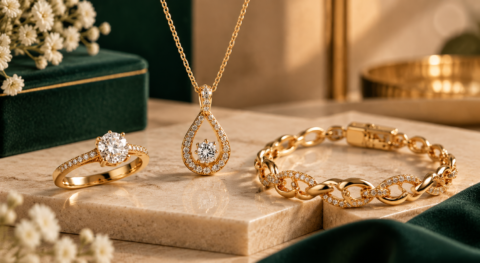


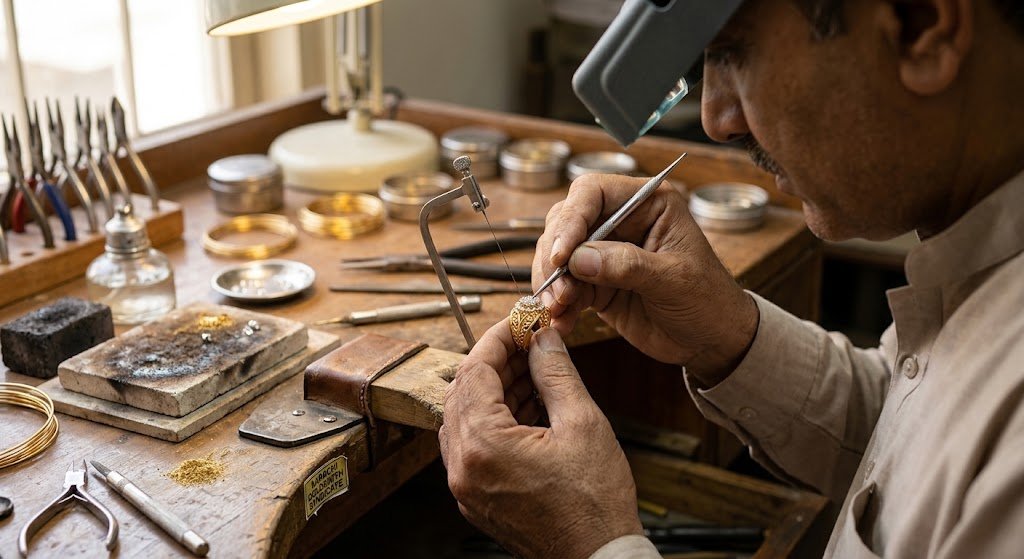
Custom gold jewellery starts with an idea, but a successful piece depends on the decisions behind it. The right size, practical proportions, clear specifications and an agreed budget matter just as much as the sketch.
Perhaps you want a pendant with a meaningful initial, a bridal necklace that sits neatly above your neckline, or a ring inspired by a family keepsake. This guide explains how to turn that idea into a wearable design and what to confirm before production begins.
Quick answer: To create custom gold jewellery, prepare a design brief, choose the gold purity and dimensions, agree on stone details and pricing, approve the final design, and inspect the finished piece against your written order.
What Is Custom Gold Jewellery?
Custom gold jewellery is made or adapted to suit your preferences. Personalisation may involve changing a chain length, adjusting a ring size or adding engraving. A fully bespoke piece usually begins with a new design and requires more discussion about structure, materials and finishing.
These options involve different amounts of work. Before requesting a quotation, explain whether you need a small change to an existing style or a design developed from the beginning.
Syed Jewellers describes its customisation options in its jewellery FAQs, including changes to gold weight, stone selection, pearl accents and chain length. Confirm what is possible for your particular piece before placing an order.
1. Write a Design Brief Before Your Consultation
A useful brief explains how you want the jewellery to look and how you will wear it. Save a few reference images, then identify the exact detail you like in each one. One might show your preferred pendant shape; another might show a suitable chain thickness.
A photograph alone cannot communicate weight, strength or comfort. Include measurements and practical requirements so your jeweller can discuss the design realistically.
- Piece: Ring, pendant, necklace, earrings, bangle or bracelet.
- Purpose: Everyday wear, a wedding, a gift or a keepsake.
- Style: Minimal, traditional, floral, geometric or a combination.
- Size: Ring size, chain length, bangle measurement or earring drop.
- Materials: Preferred gold colour, purity and any stones.
- Budget: Your maximum total, including all agreed charges.
- Deadline: The date you need the finished piece in hand.
For example: “I want a small yellow gold initial pendant for daily wear, with a smooth back and an adjustable chain. Please quote the available purity options and explain the finished weight range.” This is easier to price than “make something like this picture”.
2. Match the Design to Your Routine
Jewellery that looks beautiful in a close-up photograph should also feel comfortable after several hours. Think about sleeves, scarves, handbags, work and the jewellery you already wear.
For a ring, discuss the height of the setting and whether it may catch on fabric. For earrings, consider the weight on each ear and the fastening. For a necklace, check where the centrepiece sits when you move or bend forward.
If you are developing a pendant, our guide to choosing pendant set designs can help you think through proportions and matching pieces.
3. Choose Gold Purity, Colour and Construction
Ask your jeweller to explain which gold alloy suits the proposed structure. Purity, thickness, stone settings and workmanship all influence the result. A delicate design needs adequate support even when the aim is to keep the piece lightweight.
Gold purity and gold colour describe different things. Yellow, rose and white gold can be produced using different alloys. The World Gold Council’s explanation of gold colour and caratage is a useful independent reference when discussing these choices.
Ask whether the piece will be solid or hollow, whether the surface has a plated finish, and what maintenance that finish may need. Also confirm that “gold” in your order means the specified gold alloy throughout the relevant component, rather than a gold-coloured coating over another metal.
4. Specify Stones and Sentimental Materials Clearly
If your design includes stones, record their identity, number, dimensions and any relevant treatment information. Ask whether a stone is natural, laboratory-grown or a simulant. Similar colours can appear in very different materials.
For a significant gemstone, discuss whether an independent laboratory report is appropriate. GIA’s guidance on choosing a jeweller highlights the value of professional advice and independent reporting for gemstone purchases.
If you hope to reuse an inherited stone or old jewellery, ask for an assessment before committing. Record what you are handing over, its condition and the agreed treatment of unused materials. Do not assume every older stone can safely be removed and reset.
5. Ask for an Itemised Custom Jewellery Quotation
A bespoke quotation should explain what the price covers. Ask how the gold rate is applied, whether the price is fixed or provisional, and what happens if the final weight differs from the estimate.
| Item to confirm | Question to ask |
|---|---|
| Gold | What purity, estimated net weight and rate are used? |
| Craftsmanship | Are making charges fixed, per gram or calculated another way? |
| Design work | Are sketches, renders, samples and revisions included? |
| Stones | Are their price and specifications listed separately? |
| Other costs | Are engraving, applicable taxes and delivery included? |
| Payment | What deposit is required and when is the balance payable? |
Changing the design after approval can affect the cost and completion date. Agree on how additional work will be quoted before production starts.
6. Review the Design Before Giving Approval
Request the available sketch, render or sample and check it against your brief. A render helps explain appearance, but it cannot prove the final weight or how the piece will feel on your body.
Review dimensions, engraving spelling, stone placement, fastening and the view from the side and back. For a wedding piece, bring a photograph of the outfit neckline and discuss whether the jewellery will sit comfortably with it.
Keep a copy of the approved design and specifications. If you request a revision, make sure the latest version is clearly identified so there is no confusion about which design should be made.
7. Agree on Timing and Aftercare
Ask for a realistic completion estimate that allows for design approval, production, finishing and any adjustments. For an important occasion, leave room for a fitting rather than arranging collection on the event day.
Confirm resizing, repair and maintenance arrangements before paying a deposit. Customised pieces can have different return conditions from ready-made jewellery, so ask for the terms that apply to your order in writing.
Your Collection Day Checklist
- Compare the finished piece with the approved design and dimensions.
- Try it on and check comfort, balance and movement.
- Inspect the fastening, edges, engraving and visible finishing.
- Confirm the final net gold weight, purity and stone details on the invoice.
- Collect any agreed certificates, reports and care instructions.
- Ask how any remaining adjustment will be handled.
Before leaving, check the clasp several times and look at the piece from different angles. A small fitting issue is easier to discuss while the jeweller can inspect it with you.
Discuss Your Design with Syed Jewellers
Start by exploring the Syed Jewellers collection for shapes and styles you enjoy. Check each product’s material description, as a reference style does not establish the material or specifications of your custom order.
Then contact Syed Jewellers in Karachi with your brief, reference images, budget and required date. Ask the team to confirm design feasibility, materials and a written quotation for your piece.
Frequently Asked Questions
Can I customise an existing jewellery design?
Often, a change to size, chain length, stone selection or other details can be discussed. Syed Jewellers lists customisation options in its FAQs; availability depends on the particular piece.
Is custom gold jewellery always more expensive?
There is no fixed rule. Price depends on materials, weight, complexity, design work and labour. Compare itemised quotations with the same specifications.
Can I make custom jewellery within a fixed budget?
Share the total budget at the start. Ask which dimensions, weight or decorative details can be adjusted while maintaining suitable construction.
How long does bespoke jewellery take?
Timing depends on the design, materials, approvals and workload. Ask for an order-specific completion estimate and allow time for fitting.
Can I use an old gold piece in a new design?
Ask the jeweller to assess it first. Confirm testing, valuation, processing, any deductions and the handling of unused gold before agreeing to the work.
What should I bring to a custom jewellery appointment?
Bring a short brief, a few reference images, relevant measurements, your budget and deadline. If the piece must match an outfit, include a clear photograph of it.